CE Certified Heavy-Duty Racking Systems
Explore our factory-engineered, high-capacity structural racking products designed for cold storage, logistics hubs, and high-density manufacturing warehouses.
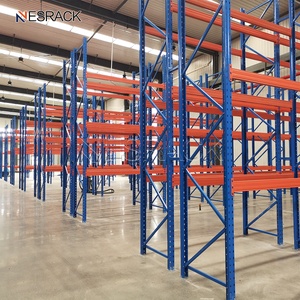
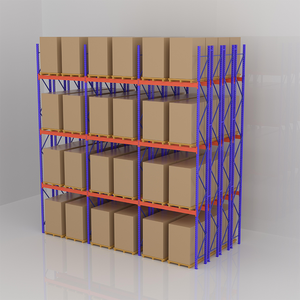
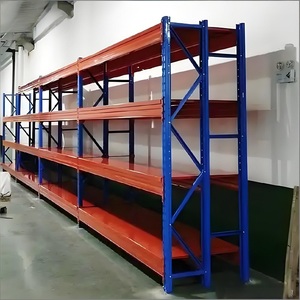
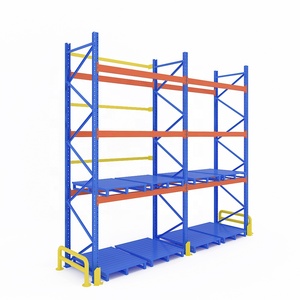
Structural Mechanics & Kinematics of Push Back Racking Systems
An in-depth technical analysis of dynamic nested trolley architectures, structural load transfer formulas, and safety compliance in modern high-density warehouses.
Nested Cart Dynamic Physics & Inclined Track Design
Push back racking operates on a precision-engineered inclined rail track (typically pitched between 1.5% and 3% gradient) combined with a series of nested, telescoping carts. When a forklift pushes the first pallet back, it exposes the nested cart beneath for the second pallet, handling configurations from 2 to 6 pallets deep.
Our engineering team utilizes structural cold-rolled steel profiles with high structural rigidity (minimum yield strength up to 355 MPa) to eliminate beam deflection under maximum loading conditions. The kinematic force required by the forklift during loading remains under 3.5% of total dynamic load weight, ensuring smooth operation without exceeding mast thrust thresholds.
Velocity Control, Anti-Drop & Deceleration Mechanics
When pallets are retrieved, gravity causes the remaining pallets in the lane to glide forward to the aisle face. To prevent dangerous acceleration spikes and impacts against the front stop beam, our Push Back systems integrate rotary dynamic fluid dampers and heavy-duty steel wheels fitted with sealed precision bearings.
The structural design incorporates secondary safety flanges on all nested trolleys to prevent cart disalignment or derailment during rapid forklift maneuvers. This mechanical locking capability is essential for passing rigorous CE compliance audits under Machinery Directive requirements.
Push Back Racking vs. Alternative High-Density Systems
A direct technical comparison matrix evaluating structural density, handling throughput, CAPEX, and operational safety metrics.
| Storage System Type | Pallet Depth Range | Space Utilization Efficiency | Selectivity Index | Forklift Collision Risk | CE / EN 15512 Structural Compliance |
|---|---|---|---|---|---|
| Push Back Racking (Nested Cart) | 2 to 6 Deep | Up to 78% | High (Per Lane Basis) | Very Low (Aisle Only) | Fully Certified (EN 15512 / CE) |
| Selective Pallet Racking | 1 Deep | 40% – 50% | 100% (Direct Access) | Moderate | EN 15512 Compliant |
| Drive-In Racking | 4 to 10 Deep | 75% – 85% | Low (Per Bay Basis) | High (Forklift Enters Rack) | Requires Heavy Column Guards |
| Pallet Live Flow (Gravity Roller) | 5 to 20 Deep (FIFO) | 85% – 90% | Moderate | Very Low | CE Certified Flow Modules |
| Radio Shuttle Racking | 10 to 40+ Deep | 85% – 92% | Low-Moderate (Automated) | Very Low | CE Machinery Directive (2006/42/EC) |
Why Direct Sourcing From Our CE Certified Factory Matters
Our manufacturing infrastructure combines automated robotic steel fabrication, strict EN 15512 structural calculation protocols, and full material traceability.
Certified Quality & CE Marking
Our push back systems are fabricated under strict ISO 9001 and ISO 14001 Quality Management Systems. Products carry CE marks in alignment with European Machinery Directive standards and EN 15512 specifications for adjustable pallet racking.
High-Tensile Q235B & Q355B Steel
We source prime structural steel coils certified by top steel mills. Upright columns and load beams undergo continuous cold roll-forming with precision punches, ensuring tight tolerances, superior torsional rigidity, and enhanced seismic resilience.
Seismic Analysis to SIA 261 & EN 1998
Every structural system is tailored to project site requirements. Our finite element analysis (FEA) accounts for localized seismic acceleration vectors (SIA 261 / Eurocode 8), dynamic load factors, and slab anchor shear limits.
Ready to Optimize Your Warehouse Floor Plan?
Download our comprehensive technical engineering catalog, load capacity charts, and CAD layout specifications.
Future Procurement Trends in Push Back Racking Systems
Key technological transformations and design evolutions shaping warehouse storage procurement over the next decade.
1. Cold-Chain & Sub-Zero Operational Reliability
As global cold-chain logistics expand rapidly for pharmaceutical and frozen food storage, modern push back racking systems are engineered with specialized low-temperature synthetic lubricants, stainless steel cart wheels, and anti-corrosive powder coatings capable of operating down to -30°C (-22°F) without mechanical jamming or material embrittlement.
2. Hybrid AGV / AMR Alignment Compatibility
The rise of Autonomous Mobile Robots (AMRs) and automated forklifts demands tighter rack manufacturing tolerances. Next-generation push back systems incorporate optical targets, laser-guided front stops, and ultra-precise entry channels that accommodate robotic pallet placement with millimeter accuracy.
3. Sensor-Assisted Telemetry & Occupancy Monitoring
Integrated IoT sensors built directly into the push back track channels allow real-time WMS (Warehouse Management System) communication. Facilities can instantly track lane occupation levels, monitor gravity return speeds, and predict maintenance schedules before component fatigue occurs.
4. Circular Economy & ESG-Driven Steel Sourcing
Enterprise procurement standardizations now mandate reduced embodied carbon. Factory production processes utilize scrap-recycled EAF (Electric Arc Furnace) steel, non-toxic epoxy coatings, and fully modular structural frame designs that allow simple scaling and structural recycling.
Frequently Asked Procurement & Engineering Questions
Detailed technical answers to common questions asked by supply chain managers, structural consultants, and warehouse buyers.
What European structural standards govern your CE Certified Push Back Racking?
Our Push Back Racking systems are calculated and manufactured in compliance with EN 15512 (Steel static storage systems – Adjustable pallet racking systems – Principles for structural design). Structural tolerances meet EN 15620, and operations align with EN 15635. The dynamic trolley elements adhere to the essential health and safety requirements of the CE Machinery Directive 2006/42/EC.
How does a Push Back Racking System handle damaged or non-standard pallets?
Because pallets sit directly on full-support nested steel carts rather than on open wheel channels, push back systems accommodate a wider variety of pallet conditions (such as GMA, CHEP, Euro-pallets, and bottom-board defect pallets) without risking dynamic jamming. However, pallets must conform to the maximum design weight specified on the rack load notice plates.
What floor slab loading capacity is required for a 4-deep Push Back rack installation?
Because push back racking concentrates heavy pallet loads into smaller footprints, point loads on concrete floor slabs are higher than selective racking. A typical 4-deep rack with 1,200 kg pallets per position requires concrete slab thickness of at least 180mm to 250mm with a minimum compressive strength of C25/30, verified against anchor bolt tension specs.
What is the maintenance lifecycle for nested trolleys and dynamic rollers?
Our carts utilize heavy-duty steel wheels equipped with sealed-for-life precision ball bearings requiring zero routine lubrication under normal indoor ambient conditions. We recommend an annual visual inspection per EN 15635 standards to check for mechanical obstructions, frame damage, or safety stop misalignment.
Can existing Selective Racking frames be retrofitted into a Push Back system?
In many cases, yes. If existing structural upright frames exhibit sufficient structural load capacity and column depth, custom push back inclined rail and cart assemblies can be mounted onto existing frames using heavy-duty structural beam connectors. Our engineering team conducts a full frame structural audit prior to retrofitting.
What is the lead time for factory-direct structural racking shipments?
Standard manufacturing lead times range from 3 to 5 weeks upon final layout approval and structural sign-off. Full container shipments are packed using protective steel banding and timber framing to prevent surface coating abrasion during ocean transit.
Request Your Custom Push Back Racking Proposal
Contact our structural engineering team today for complimentary CAD design, floor load analysis, and factory-direct pricing.