Technical White Paper: Structural Integrity & Compliance of CE Certified Industrial Storage Systems
Modern industrial supply chains demand uncompromised structural reliability, maximum cubic volumetric utilization, and strict adherence to international safety standards. Selecting CE certified industrial shelving and storage rack factories is not merely a purchasing decision; it is an executive risk mitigation strategy. Racking systems act as load-bearing steel structures subjected to dynamic forces, fork-truck impact actions, thermal fluctuations, and in high-risk zones, seismic accelerations.
This technical white paper synthesizes structural design standards (EN 15512, EN 15620, SIA 261), material metallurgical grades (Q235B/Q355B high-yield cold-formed steel), and total cost of ownership (TCO) principles to guide warehouse procurement directors, structural engineers, and logistics infrastructure planners.
Core Compliance Engineering Takeaway: EN 15512:2020 Standard
Under the European standard EN 15512 (Steel static storage systems - Adjustable pallet racking systems - Principles for structural design), racking structures must be calculated using Finite Element Analysis (FEA) accounting for non-linear global frame stability, beam-to-upright connection stiffness (rotational spring stiffness $K_{b}$), and base-plate floor anchorage interaction. CE-certified manufacturers certify load capacities through physical destructive testing and mathematical modeling.
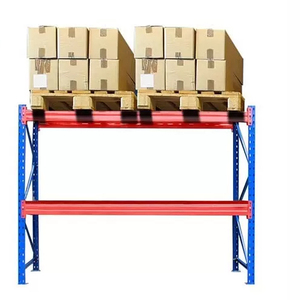
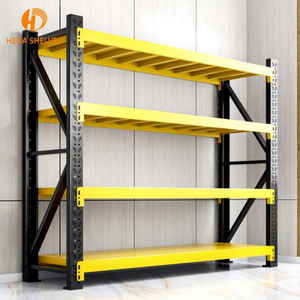
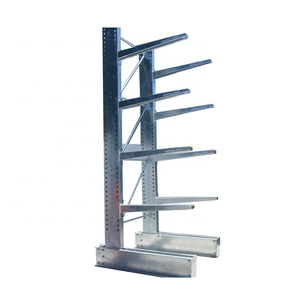
1. Anatomical Engineering of CE Certified Heavy-Duty Racking
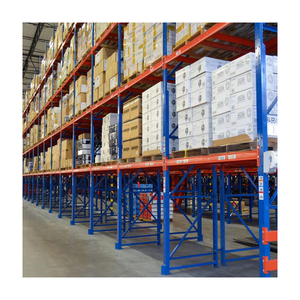
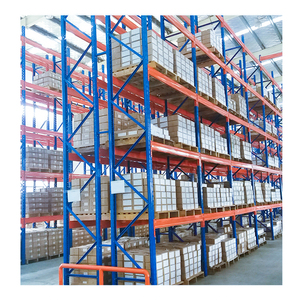
Industrial storage systems rely on structural synergy across cold-formed steel profiles. Understanding profile geometry, shear performance, and connection mechanics is mandatory when verifying factory structural claims:
A. Upright Frame Assemblies & Profile Geometry
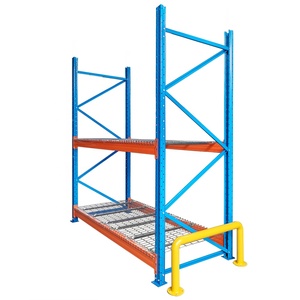
Uprights are cold-roll-formed from continuous high-tensile steel strip into multi-flanged columns (omega profile shapes). The presence of multiple return bends elevates the structural moment of inertia ($I_x$, $I_y$) while minimizing total steel weight. Key structural parameters include:
- Steel Metallurgy: Q235B grade (yield strength $f_y \ge 235 \text{ N/mm}^2$) or high-tensile Q355B ($f_y \ge 355 \text{ N/mm}^2$) for high-bay applications up to 30 meters height.
- Punch Pattern Tolerances: Precision teardrop or teardrop/hook-in slots punched at 50mm, 52.07mm (2-inch), or 75mm pitches. Precision punching limits mechanical play, preventing sway frame deviation under full capacity loading.
- Bracing Configurations: Alternating diagonal and horizontal bracing channels (C-sections or tube profiles) bolted with high-grade 8.8 structural fasteners to withstand lateral shear loads.
B. Box Beams & Connector Lock Mechanisms
Beams transfer vertical pallet loads to upright frames. Double-C nested box beams, welded continuously along the neutral axis via robotic MIG welding, exhibit superior torsional resistance compared to open step beams. Beam connectors feature 3 to 5 claw hooks forged from heavy-gauge plate, engaging tightly with upright slots. A mandatory safety locking clip prevents accidental dislodgements from forklift upward thrusts during rapid pallet retrieval.
Structural Standard Comparison: Standard Racking vs. CE Certified EN 15512 Engineered Systems
| Structural Benchmark | Standard Market Racking | CE Certified (EN 15512 / SIA 261) |
|---|---|---|
| Structural Calculation | Simplified static point-load estimation | Non-linear Finite Element Analysis (FEA) + 2nd Order Effects |
| Beam Deflection Limit | $L / 150$ or $L / 180$ (causes permanent sagging) | Strict $L / 200$ of span length under maximum allowable load |
| Material Traceability | Mill test certificates optional | 100% Traceable EN 10204 3.1 steel batch certification |
| Seismic Coefficient | Not evaluated | Dynamic modal spectrum calculation (SIA 261 Z1a to Z3b / FEM 10.2.08) |
| Weld Integrity | Manual visual check | Robotic continuous welding certified to ISO 3834-2 / EN 1090-2 |
| Coating Durability | Basic single-pass spray painting | Automated multi-stage wash + thermosetting epoxy powder coat (ISO 12944) |
2. Factory Manufacturing Rigor & Quality Control Protocols
True E-E-A-T (Experience, Expertise, Authoritativeness, and Trustworthiness) in industrial racking supply stems from manufacturing transparency. Reputable factories operate under fully integrated Quality Management Systems (ISO 9001:2015, ISO 14001:2015, ISO 45001:2018).
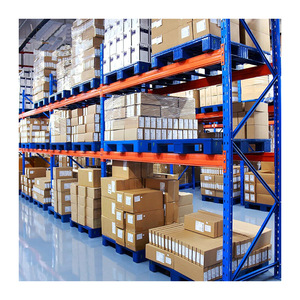
Inside Our Certified Manufacturing Facilities
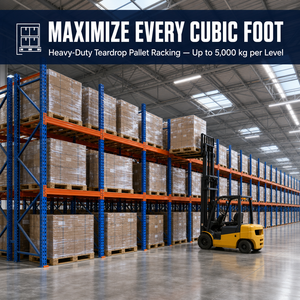
Every beam, upright column, and baseplate passes through automated roll-forming, laser cutting, robotic welding, and electrostatic powder coating processing lines:


Automated manufacturing minimizes human error in weld penetration, beam squareness, and hole alignment. Raw materials undergo tensile testing ($R_m$, $R_{eH}$), bend testing, and spectral chemical analysis prior to cold forming. Components undergo surface pre-treatment (iron phosphating or zinc-zirconium washing) to maximize powder coating adhesion, preventing corrosion creep even in cold storage facilities operating down to $-30^\circ\text{C}$.
3. Emerging Procurement Trends in Industrial Storage (2025–2030)
The global logistics landscape is undergoing rapid structural transformation driven by supply chain consolidation, urban land scarcity, and high automation adoption. Procurement directors must align storage investments with three macro trends:
Trend 1: High-Density Semi-Automated & ASRS Integration
Conventional selective pallet racking requires 3.0 to 3.8-meter forklift aisles, occupying over 60% of total warehouse floor area. Enterprise buyers are shifting aggressively toward Radio Shuttle Systems, Drive-In Racks, and Automated Storage & Retrieval Systems (ASRS). Radio Shuttle installations utilize autonomous battery-powered carts moving along internal channels, reducing aisle requirements to a single retrieval zone and increasing pallet volumetric density by up to 80%.
Trend 2: Seismic-Resilient Engineering to SIA 261 & FEM Standards
Seismic events present severe collapse risks to high-bay racking systems. Modern procurement specs mandate seismic acceleration analysis taking into account ground acceleration factors, soil foundation coefficients, and live storage payload interactions. Racking columns intended for seismic zones require oversized baseplates, chemical anchor studs, heavy-duty floor shims, and high-ductility diagonal bracing arrangements.
Trend 3: Smart IoT Structural Monitoring & Wire Mesh Safety Integration
Safety regulations increasingly mandate secondary protection accessories. Drop-in wire mesh decking (manufactured to ANSI MH26.2 standards) prevents loose cargo falling while maintaining open area for overhead fire protection sprinkler systems. Furthermore, IoT strain gauges and optical sensor arrays are entering high-bay automated distribution facilities to measure real-time column deflection and alert operations teams to forklift impact damage before cataclysmic structural failure occurs.
4. Frequently Asked Questions (FAQ) for Industrial Procurement
Which European standards apply to industrial selective pallet racking and shelving? +
Industrial pallet racking in Europe and international markets following EU directives must comply with EN 15512 (structural design), EN 15620 (tolerances, deformations, and clearances for automated and manual systems), and EN 15635 (the code of practice for operation and maintenance of storage equipment). In addition, factory production control standards EN 1090-1 / EN 1090-2 govern structural steel execution classes (EXC1 and EXC2).
How does CE certification impact safety liability for warehouse operators? +
CE certification confirms that storage equipment satisfies essential health, safety, and environmental directives (such as the Construction Products Regulation CPR 305/2011 or Machinery Directive where automated drive components are included). Selecting CE-marked storage protects facility owners against structural liability claims and ensures compliance during municipal safety audits and insurance underwriting inspections.
What is the difference between roll-formed steel racking and structural steel racking? +
Roll-formed racking is manufactured by cold-forming continuous sheet steel coil into complex multi-flanged profile shapes. It offers an exceptional strength-to-weight ratio, easy level adjustability, and lower cost. Structural steel racking uses hot-rolled structural C-channels or structural I-beams. Structural racking offers superior resistance to fork-truck impact and extreme heavy-unit loading, though at a higher initial capital expenditure.
How do I determine the correct beam loading and frame capacity for my layout? +
Frame capacity depends on the height of the first beam level (unsupported length $L_u$), total vertical storage bays, ground anchor conditions, and local seismic requirements. Beam capacity is calculated based on Uniformly Distributed Loads (UDL) per pair of beams, respecting the maximum deflection limit of $L / 200$. Our qualified structural engineering team provides custom structural calculations and load signs for every installation.
Can your racking systems be installed in cold storage facilities down to -30°C? +
Yes. Storage systems for sub-zero freezer environments utilize specialized cold-resistant steel grades certified for impact toughness at low temperatures (preventing embrittlement). Coatings can be upgraded to hot-dip galvanizing to ISO 1461 or high-durability cold-store epoxy powder coats.